- What is this product?
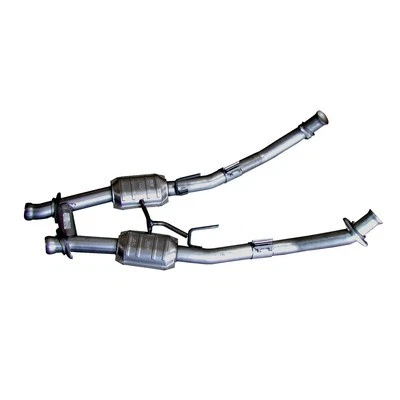
- It is a 2.5-inch catted H-pipe for compatible 1986–1993 Ford Mustang SBF applications.
- What does SBF mean?
- SBF stands for Small-Block Ford.
- What years does it fit?
- It is intended for compatible 1986 through 1993 Ford Mustang models.
- What pipe size does it use?
- 2.5-inch tubing.
- What does “catted” mean?
- It means catalytic converters are incorporated into the mid-pipe.
- What does an H-pipe do?
- It connects the left and right exhaust banks with a crossover passage to help balance exhaust pulses and shape the exhaust tone.
- Where does this H-pipe install?
- It installs under the vehicle between the headers or exhaust manifolds and the cat-back exhaust system.
- Does it include catalytic converters?
- Yes, based on the catted product description.
- Does it include oxygen sensors?
- Not unless specifically stated.
- Does it include gaskets?
- It may. Verify the exact package contents.
- Does it include mounting hardware?
- It may.
- Does it include clamps?
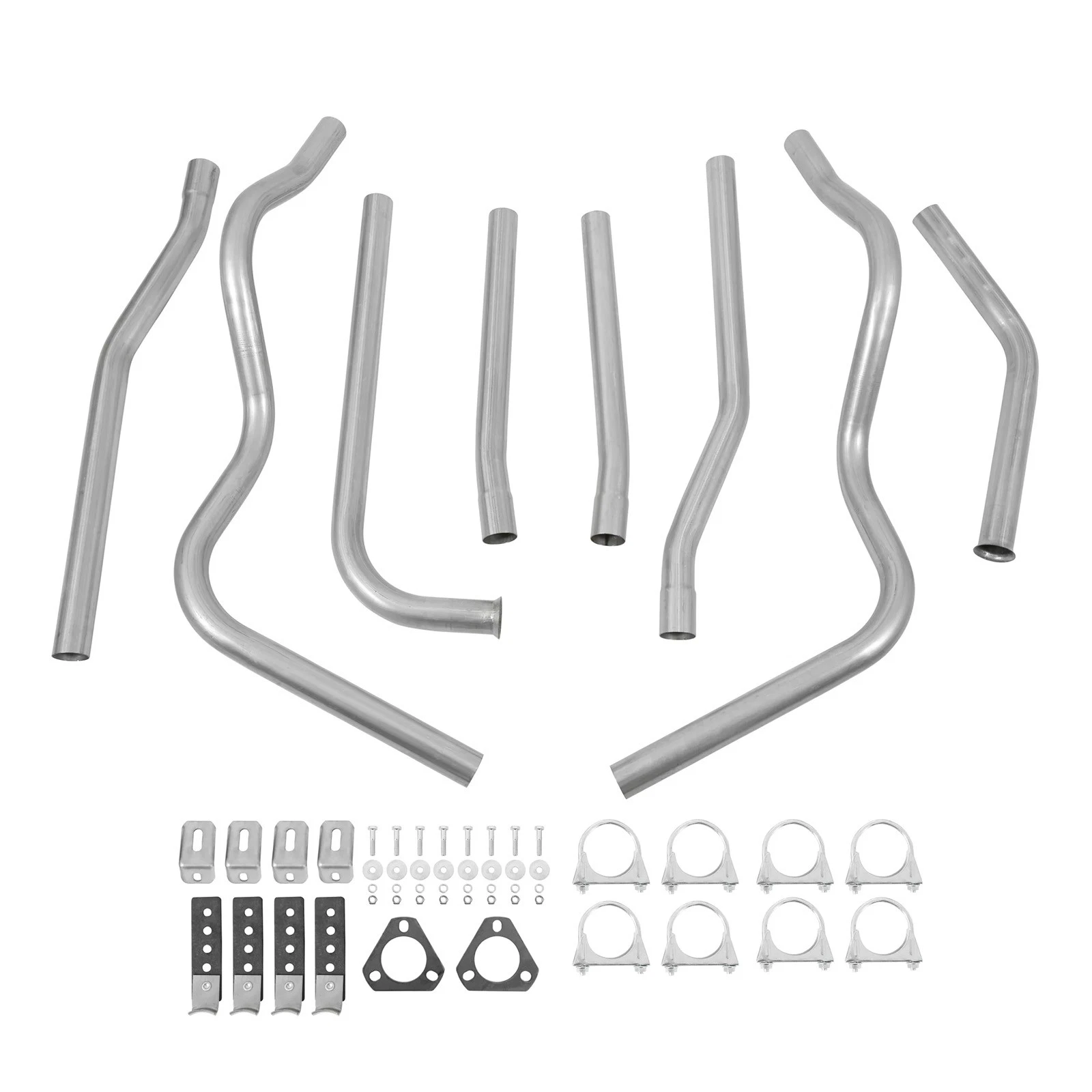
- Possibly, depending on the exact kit.
- Is this designed for the 5.0L Mustang?
- It is intended for compatible Small-Block Ford Mustang exhaust configurations, which commonly include the 5.0L V8.
- Can it work with factory exhaust manifolds?
- Possibly, if the front connection geometry and flange arrangement match.
- Can it work with shorty headers?
- Yes if the H-pipe is designed for the specific shorty-header outlet locations.
- Can it work with long-tube headers?
- Usually not without a matching long-tube mid-pipe.
- Why do long-tube headers often require a different mid-pipe?
- Their collectors usually end farther rearward than factory manifolds or shorty headers.
- Can it connect to a factory-style cat-back?
- Yes if the rear connection size and location match.
- Can it connect to an aftermarket cat-back?
- Yes if the diameter and connection layout are compatible.
- Can it work with Flowmaster mufflers?
- Yes, provided the rest of the system is compatible.
- Can it work with MagnaFlow or similar exhaust systems?
- Yes, if the pipe size and connection points match.
- Will it make the car louder?
- It can change overall volume and tone depending on the headers, mufflers, and tailpipes.
- What kind of sound does an H-pipe produce?
- H-pipes are commonly associated with a deeper, more traditional American V8 exhaust tone.
- How does an H-pipe usually sound compared with an X-pipe?
- An H-pipe generally sounds deeper and more classic, while an X-pipe often sounds smoother and higher-pitched at higher RPM.
- Which is better, H-pipe or X-pipe?
- It depends on your sound preference, engine setup, and exhaust goals.
- Will this increase horsepower?
- It may reduce restriction and improve exhaust flow, but actual power gains depend on the complete engine and exhaust combination
- Can I expect a specific horsepower increase?
- No specific gain should be assumed without dyno testing.
- Can it improve throttle response?
- Reduced exhaust restriction can improve response in some applications.
- Can it be used with a supercharger?
- Possibly, if the 2.5-inch exhaust capacity and converters are suitable for the engine’s power level.
- Can it be used with a turbocharger?
- Not necessarily. Turbo systems often use custom downpipe and mid-pipe routing.
- Is this a direct replacement for every 1986–1993 Mustang?
- No. Engine, header, manifold, transmission, and existing exhaust configuration must be verified.
- Should manual versus automatic transmission be verified?
- Yes if the manufacturer lists separate applications.
- What dimensions should be compared?
- Compare front flange positions, overall length, crossover location, converter position, rear connections, and sensor bungs.
- What is the estimated product weight?
- Approximately 30–45 lb depending on material, tubing thickness, converter design, and hardware.
- What shipping weight should I use?
- Approximately 50 lb is a practical estimated packaged weight.
- Why can shipping weight vary?
- Converter construction, tubing, flanges, mounting hardware, gaskets, and packaging affect the final weight.
- What should I verify before ordering?
- Confirm the 1986–1993 Ford Mustang model year, SBF engine configuration, factory manifold or header type, shorty versus long-tube setup, 2.5-inch pipe diameter, front flange geometry, rear cat-back connection, oxygen-sensor locations, transmission and chassis clearance, local emissions requirements, and exact package contents before purchase.